
[Integrated Biomarker and Imaging-assisted Screening for Prostate cancer]
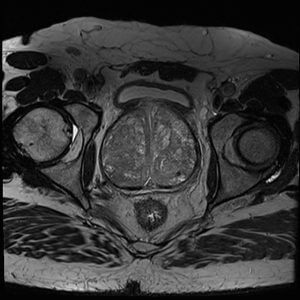
Develop an AI model that predicts clinically significant prostate cancer using clinical data from urology, laboratory, radiology and pathology, and raw data from prostate MRI’s.
Objective
The IBIS-PRO project seeks to enhance screening for clinically significant prostate cancer through several key initiatives:
- Advancing AI models for more accurate prediction of clinically significant prostate cancer, by exploring a range of models, from supervised learning techniques to unsupervised autoencoders.
- Building a high-quality, curated dataset where each datapoint is manually reviewed and corrected by medical professionals as needed. Additionally, blood test results will be calibrated to ensure consistency, eliminating variations caused by different laboratory equipment or vendors.
- Developing a flagging tool to identify patients at risk of a false-negative biopsy, where prostate cancer may have been missed despite a negative biopsy result.
Methodology
- Data collection and curation
- Classification of clinically significant prostate cancer using clinical data from radiology, pathology, and laboratory.
- Classification of clinically significant prostate cancer using raw MRI data. Self-supervised pre-training methods will be researched and implemented
- Classification of clinically significant prostate cancer using clinical data from radiology, pathology, and laboratory, and raw MRI data.
Impact and future directions
[benefits for patients and future plans or next steps for the project]
This project has the potential to significantly enhance prostate cancer screening. By utilizing AI models, doctors will be able to make more informed decisions about when a biopsy is necessary, hereby reducing the number of unnecessary procedures.
General info and contact
Keywords (#): AI, machine learning, deep learning, Prostate cancer, PSA, Phi, self-supervised learning, PI-RADS
RADar project research lead: Ir. Fanny D’Hondt
Principal investigator: Prof. MD Geert Martens
Timeline: August 2024 – August 2026
Status: The IBIS-PRO project started in August 2024. Currently, data from the various hospital departments is being collected, manually checked and corrected if needed. In the meantime, research is done on masked autoencoders for feature extraction of raw MRI scans.
Partners: Gevaert Lab from Stanford University
Funding: The IBIS-PRO project is funded by a 2-year innovation grant from VLAIO.
 RADar - Learning & Innovation Center